

GLOBAL CONNECTIONS, LIMITLESS GROWTH
Competitiveness of Polish Food in the Era of EU Trade Agreements: Conclusions from the WorldFood Poland 2026 Debate
24/09/2026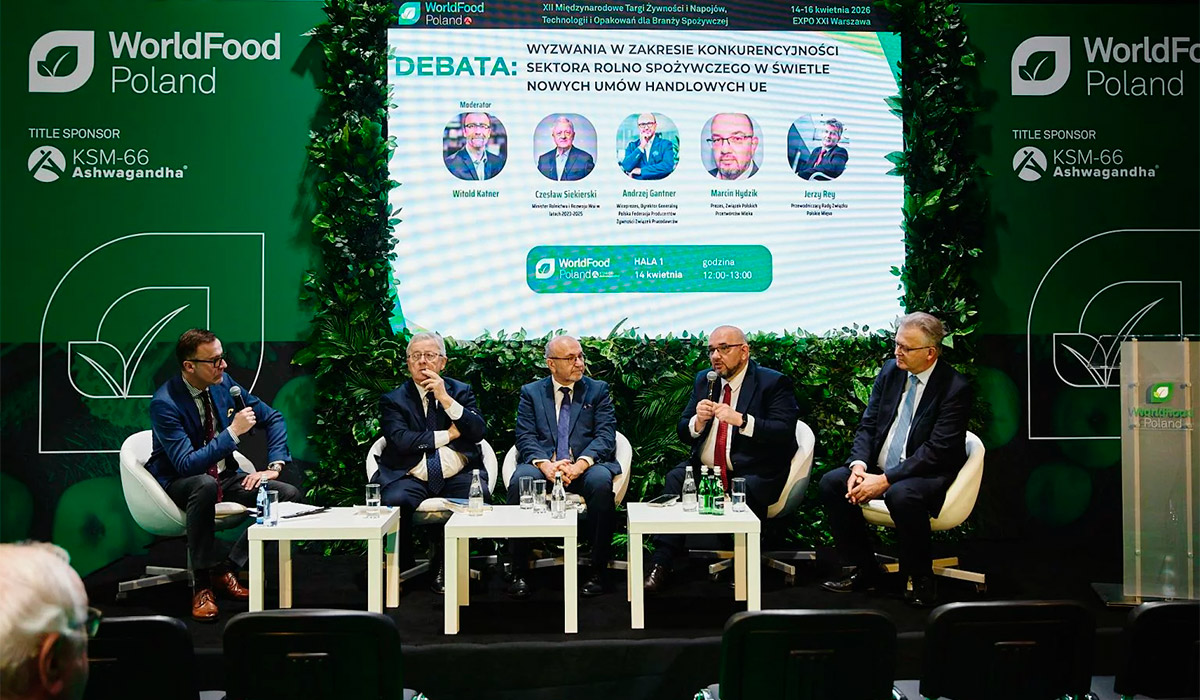
Are European Union trade agreements opening new markets for Polish food—or exposing domestic producers to unequal competition? During WorldFood Poland 2026, leading agri-food experts examined the opportunities and risks created by expanding global trade, highlighting concerns over regulatory costs, inconsistent production standards and insufficient support for one of Poland’s strongest export sectors.
WorldFood Poland brings together producers, processors, industry organisations and policymakers who influence the future of the Polish agri-food sector. On 14 April 2026, the exhibition hosted a debate entitled “Challenges in the Competitiveness of the Agri-Food Sector in the Light of New EU Trade Agreements.”
The discussion featured Czesław Siekierski, former Minister of Agriculture and Rural Development; Andrzej Gantner, Vice-President and Director General of the Polish Food Producers Federation; Marcin Hydzik, President of the Polish Dairy Processors Association; and Jerzy Rej, Chairman of the Council of the Polish Meat Association.
Their message was clear: free trade remains essential to the growth of Polish food exports, but new agreements must be accompanied by fair standards, effective safeguards and stronger institutional support.
Free Trade: Opportunity or Threat?
The European Union has concluded approximately 48–49 free trade agreements designed to reduce tariffs and other barriers to international commerce. These agreements create export opportunities, but they also give overseas suppliers greater access to the European market.
Andrzej Gantner illustrated the challenge with a simple analogy:
“Before you invite guests into your home, you must tidy it up properly—you must prepare yourself for them.”
In his view, the issue is not free trade itself, but whether the European agri-food sector is adequately prepared to compete. Rising regulatory, environmental and production costs are weakening the position of EU companies against suppliers operating under less demanding conditions.
Marcin Hydzik highlighted the cumulative impact of successive agreements. Poland’s dairy industry exports approximately 30% of its production, with 72% of that volume remaining within the EU and Germany alone accounting for 20%.
While the import quotas included in an individual agreement may appear limited, their combined effect across dozens of agreements can significantly increase competitive pressure on the EU market.
“Each one of them, if you put them all together, starts to become a problem,” Hydzik said.
Different Agreements, Different Challenges
The proposed agreement with Mercosur countries—Argentina, Brazil, Paraguay and Uruguay—has generated particular concern because South American agricultural products may be produced under conditions that differ substantially from EU requirements.
Jerzy Rej noted that animals in Poland are identified and monitored throughout their lives, while cattle intended for export from Argentina may only be reported to veterinary authorities shortly before shipment.
“This is a completely different world, and suddenly we are expected to compete with these different worlds,” he said.
The participants argued that effective controls should begin in the country of origin and continue at the EU border. Safeguard clauses must be practical, enforceable and embedded in agreements from the outset rather than introduced as a last-minute political response.
Ukraine presents a different challenge. As a neighbouring country with significant agricultural capacity and ambitions to align with EU standards, it is both an important partner and a powerful future competitor.
Gantner warned that Ukrainian suppliers will naturally target the most attractive and accessible European markets. Czesław Siekierski added that insufficient attention is being given to how Ukraine’s eventual EU accession could affect Polish agriculture and food processing.
India and Australia present different circumstances. India is the world’s largest milk producer but maintains strong protection of its domestic market. Australia, meanwhile, offers potential opportunities for Polish meat exporters, although sanitary restrictions—including its approach to African swine fever—continue to limit access.
Despite these obstacles, Rej stressed that Poland should not withdraw from international trade. Polish beef has already entered major markets such as South Korea and the Philippines, demonstrating the potential for further expansion. The objective should therefore be to manage trade risks while pursuing new opportunities.
EU Standards: Competitive Advantage or Costly Barrier?
European food enjoys a strong international reputation for quality and safety. Gantner recalled that during a trade mission to Japan, European origin was viewed as an important guarantee by local partners.
This reputation has been built through years of regulation, inspections and investment by European producers. However, the speakers warned that admitting products manufactured under less demanding standards could undermine this advantage. European companies may face pressure from lower-priced imports while consumer confidence in EU food standards could also be weakened.
The European Commission maintains that new agreements include sanitary and veterinary safeguards. Industry representatives, however, questioned whether existing mechanisms will be sufficient as imports grow.
The EU’s Rapid Alert System for Food and Feed identifies unsafe products, but it generally responds after goods have entered the market. Debate participants therefore called for stronger controls at source and greater investment in border inspections, particularly in countries such as Poland that form part of the EU’s external frontier.
Siekierski also highlighted the institutional imbalance between agricultural and trade priorities at EU level. Trade policy often focuses on overall economic benefits, while the specific interests of farmers and processors receive less attention.
A more coordinated approach is needed—one that connects agriculture, raw materials, food processing, trade, infrastructure, insurance and export promotion.
A Strategic but Undervalued Sector
Agriculture and food processing together account for a significant share of Poland’s economy and consistently generate a positive trade balance. Yet processing is often treated merely as an extension of agriculture rather than as a major economic sector in its own right.
The dairy industry alone generates approximately EUR 4 billion in exports, with a growing proportion coming from cheeses and other higher-value processed products rather than basic commodities such as powders and butter.
According to the speakers, Poland’s future export success will depend on three priorities: consolidation, scale and economic diplomacy.
Siekierski pointed to the Netherlands as an example of a country that treats trade as a specialist competence. Dutch businesses successfully export products they do not necessarily produce themselves because they have developed strong commercial networks, logistics and market expertise.
Poland, by contrast, needs to rebuild its economic diplomacy and ensure that the food industry receives stronger representation abroad. Producers must also cooperate more closely. Large international contracts require either major suppliers or coordinated groups of smaller companies capable of negotiating collectively.
Without greater integration between farmers and processors, Polish businesses may struggle to match the bargaining power of global retailers and purchasing platforms.
What Needs to Change?
Gantner concluded the debate with five proposals that could strengthen the competitiveness of Poland’s agri-food sector:
- Introduce genuine deregulation, measured by actual savings for businesses.
- Halt new cost-increasing regulations until existing burdens have been addressed.
- Develop EU regulations through consultation and industry consensus.
- Recognise food processing as a strategic part of the economy.
- Strengthen state support for exports, including promotion, insurance and economic diplomacy.
Rej also called for a temporary moratorium on new regulations to give businesses the legal stability needed for investment and long-term planning.
Hydzik warned against imposing additional domestic costs on industries already operating with narrow margins. Polish companies cannot compete effectively abroad if regulation continues to increase production costs at home.
Siekierski also advocated creating a dedicated processing and trade department within the Ministry of Agriculture and Rural Development. Such a body could coordinate agricultural production, processing and exports while helping to address the fragmentation that currently limits the sector’s influence.
He further emphasised the importance of industry cooperation:
“You are being outmanoeuvred by major retail platforms if you are not organised.”
Industry chambers, federations and associations must therefore speak with a stronger, more unified voice. The role of government should be to support, defend and advise the sector while allowing businesses to lead commercial development.
Preparing Polish Food for Global Competition
The WorldFood Poland debate demonstrated that free trade is both necessary and unavoidable. Polish food producers need international markets, and trade agreements can help provide access to them. The central question is not whether Poland should participate in global trade, but how the sector can compete fairly and sustainably.
Three priorities emerged from the discussion:
- Cost competitiveness, particularly in the face of rising regulation and production expenses.
- Protection of EU quality and safety standards, which represent one of European food’s greatest international advantages.
- Stronger organisation and institutional support, enabling Polish businesses to compete with global retailers, foreign governments and international suppliers.
Poland’s agri-food sector has the quality, experience and production capacity to succeed internationally. Maintaining that momentum will require consistent regulation, stronger economic diplomacy, coordinated export support and a more prominent role for food processing in national economic policy.
WorldFood Poland provides an important platform for these discussions. Beyond showcasing products and connecting buyers with suppliers, the exhibition allows business leaders, industry organisations and policymakers to confront the issues shaping the future of Polish food—and to turn shared concerns into practical recommendations.